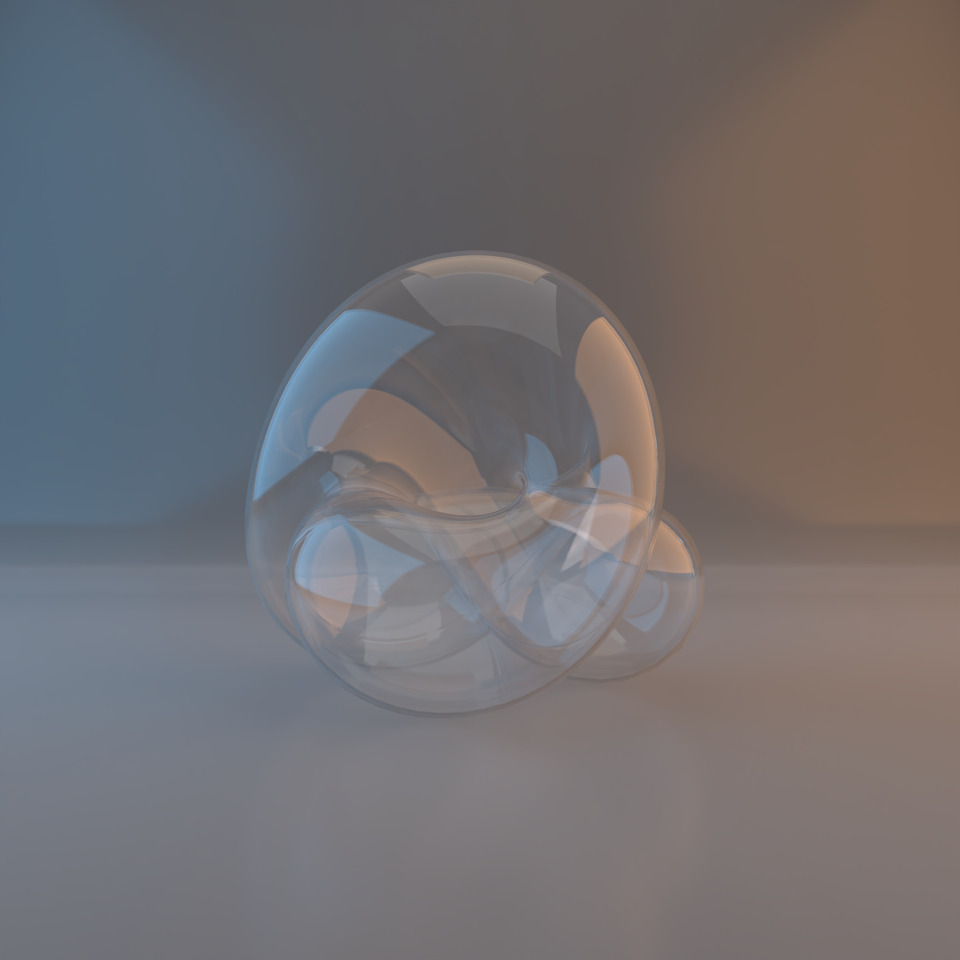
Boy’s surface
The surface in the picture
Non-orientable surfaces, like the Klein bottle, cannot be embedded into three-dimensional space. What if we allow self-intersections, i.e. immersions? Some non-orientable surfaces, like the Klein bottle, can be immersed into three-dimensoinal space; however, it was not known, before 1901, whether the projective plane can be immersed into three-dimensional space.
The (real) projective plane has several equivalent descriptions. The simpliest description is the quotient of the -sphere under the antipodal map; that is, take a -sphere and glue antipodal points together. It’s immediate that we can ignore one hemisphere of the sphere, so we get the second description: take a hemisphere, or equivalently a -disk, and identify antipodal points on its boundary. Now if we focus on the boundary, we notice that the boundary is still a circle after the identification, but the way of attachment of disk is different now: the disk is attached to the circle by winding its boundary two times around the circle. Therefore we get a third description, which essentially gives it a CW complex structure.
David Hilbert asked his student, Werner Boy, to prove that cannot be immersed in . However, in 1901, he proved that it actually can be immersed; this immersion is now called Boy’s surface.
Method of production
The Boy’s surface has many parametrizations. I chose the Kusner–Bryant parametrization here for its round and beautiful shape. The parametrization is given by , where
and inside the complex unit disk.
The image is produced in Blender. I thought it would be easy given the parametrization, but it turns out quite complicated, mainly because the surface is closed but the domain of has a boundary, so the resulting surface had a seam. I needed to figure out the periodicity conditions of this parametrizations to close up the seam, and after some trial-and-error I finally got it right.