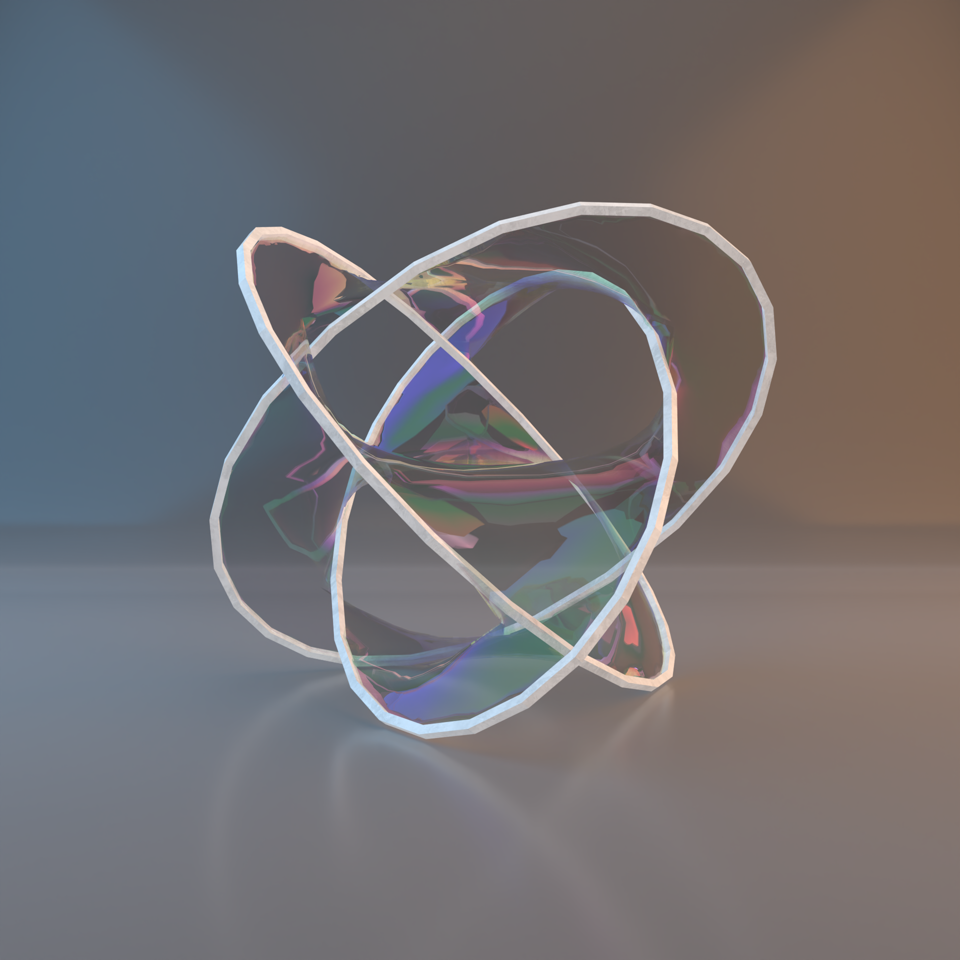
Seifert surface of the Borromean rings
The surface in the picture
The Borromean rings form a link of three circles in with the property that no two of them are linked, and yet the three together cannot be pulled apart: cut any one of them and the other two come free. Every pair has linking number , so no account of the rings taken two at a time can tell them from three circles laid out side by side; what holds them is a property of all three, which is why they are the standard example of a link whose pairwise invariants say nothing.
Every embedded link in admits a Seifert surface, which is an embedded orientable surface with no self-intersections, with the link as its boundary. Seifert surfaces are not unique; for example, any Seifert surface of genus can be modified into one with genus via a surgery, and different configurations of the same knot has different Seifert surfaces. The least genus among all Seifert surfaces of all configurations of the link is called the Seifert genus of the link. For the Borromean ring, its Seifert genus is .
Method
The image is created in Blender. The rings are easy, but the surface took me quite some time. There is an application, SeifertView, which can calculate and visualize Seifert surfaces for any link; a private version of it can also export the mesh of the surface. I requested for a copy but got no response. Therefore, I hand-drawn the surface in Blender, using SeifertView as visual reference. The resulting surface was rough and consists of plane polygons. To smooth it out I subdivided them and used the spring-mass physics in Sverchok to let it evolve into a visually smooth surface.